
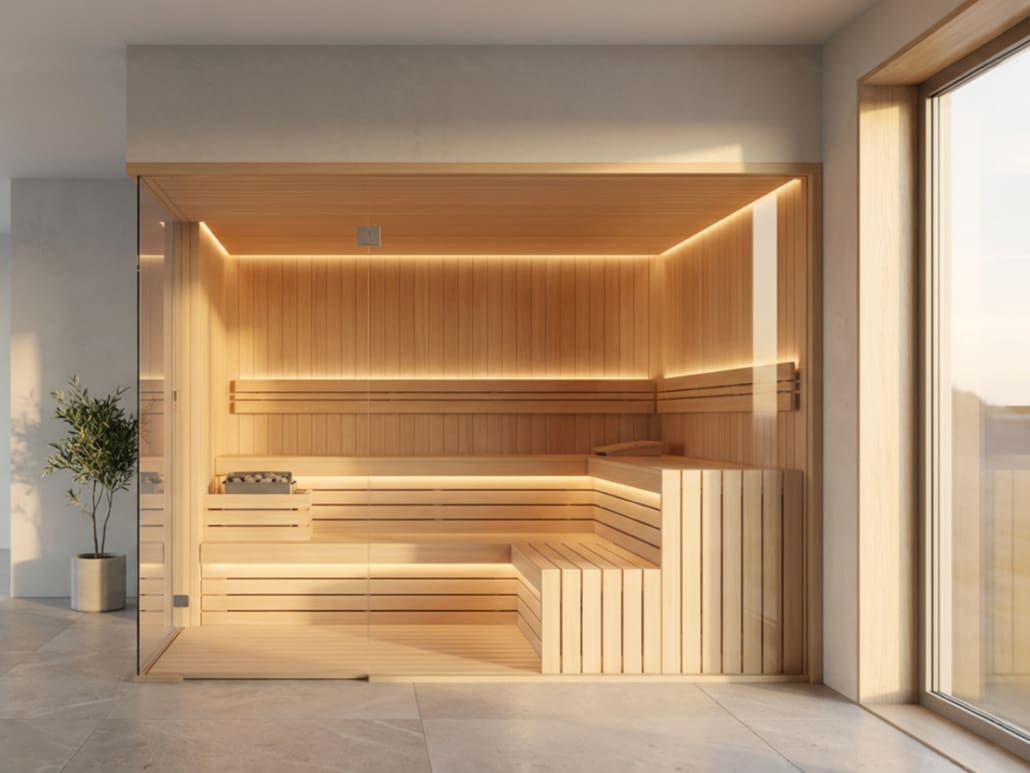
Finnish sauna: what it is, how it works, and what you need to decide before integrating it into your project
The Finnish sauna is a dry heat bath taken in a wooden cabin at temperatures between 80 and 100 °C, with low relative humidity (between 10 and 20%). This combination triggers deep sweating that activates circulation, relaxes muscles, and generates a sustained sense of calm.
It is the benchmark thermal experience: the most scientifically studied and, when well integrated into architecture, one of the elements that adds the most value to a wellness project —whether residential or in hospitality.
What exactly is a Finnish sauna
The Finnish sauna —also called a dry sauna or Finnish sauna— is defined by three fundamental parameters:
- Temperature: between 80 and 100 °C on the upper benches.
- Humidity: between 10 and 20% under normal conditions. It can increase momentarily by pouring water over the stones (the process called löyly in Finnish).
- Structure: a wooden cabin with multi-level tiered benches, where heat stratifies naturally: more intense the higher you go.
The result is a dry, enveloping, and very hot environment that the body perceives as an intense yet controllable stimulus, especially when combined with a subsequent cooling phase.
Origin and culture of the Finnish sauna
The sauna has been an essential part of Finnish identity for over 2,000 years. It was originally used as a winter residence, a place for childbirth, and a weekly hygiene space. Over time, it evolved into a ritual for relaxation, socialization, and body care.
Today, Finland has more saunas than cars, and the practice has spread across the globe —hotels, spas, luxury residences, sports centers— as one of the most established elements of contemporary wellness.
How a Finnish sauna works: key elements
The heater (kiuas)
It is the heart of the system. It can be electric (the most common in modern installations due to its precise control and immediate start) or wood-burning (more traditional, valued for its higher quality löyly). The heater warms the volcanic stones which, thanks to their high thermal capacity, accumulate and release heat gradually and steadily.
Volcanic stones
They regulate the temperature and enable the löyly: when water is poured over the hot stones, it evaporates instantly, creating a steam shock that briefly and intensely increases humidity, making the heat feel more enveloping.
The wood
The structural material plays both a technical and a sensory role. Good sauna wood must have low thermal conductivity (so benches do not burn to the touch), low resinification under heat, and high resistance to humidity. The most widely used species in premium projects are aspen, thermo-magnolia, Canadian hemlock, and ayous. The choice affects durability, touch, aroma, and the overall look of the cabin.
Ventilation
The sauna requires a specific ventilation system that renews the air in a controlled manner —usually between three and five times per hour— without compromising temperature or comfort. A correct ventilation design is invisible to the user but decisive for hygiene, thermal stability, and the durability of the installation.
The benches
They are arranged at different levels because heat stratifies: higher up means higher temperature. The lower level can be at 60–70 °C; the upper level at 90–100 °C. Users choose their position according to their tolerance and preference.
Sauna types: differences and when to choose each one
| Type | Temperature | Humidity | User profile |
|---|---|---|---|
| Finnish sauna | 80–100 °C | 10–20 % | Intense dry heat, deep sweating, contrast |
| Biosauna | 50–60 °C | 45–65 % | Moderate heat, more tolerable, broader use |
| Steam bath / Hammam | 40–50 °C | 100 % | Moist heat, respiratory benefits, enveloping environment |
| Infrared sauna | 40–60 °C | Dry | Deep heat at lower temperature, longer sessions |
| Smoke sauna (savusauna) | 70–90 °C | Medium | Ancestral version, unique experience, requires time and skill |
The Finnish sauna is the gold standard option when looking for the complete thermal experience: intensity, calm, contrast, and a clear ritual.
“We design wellness experiences that fit your project and stand the test of time”
Benefits of the Finnish sauna
Scientific evidence regarding regular sauna use is robust and growing. Without making medical claims, the most relevant studies point to:
- Cardiovascular benefits. Research by Professor Jari Laukkanen’s group (University of Eastern Finland) shows that a 30-minute session can contribute to lowering systolic blood pressure and improving vascular compliance, with effects similar to moderate-intensity exercise.
- Muscle relaxation. Heat promotes vasodilation, improves tissue oxygenation, and facilitates post-exertion muscle recovery. Especially relevant in sports environments and high-use hospitality settings.
- Immune response. The hot-cold alternation has been associated with increased white blood cell production and a lower incidence of respiratory infections in regular users.
- Psychological well-being. Exposure to heat stimulates endorphin release and reduces cortisol levels. The feeling of calm that follows a properly conducted session is one of the most valued effects.
- Skin care. Deep sweating contributes to natural pore cleansing and cell renewal. Improved circulation can stimulate collagen production.
Note: INBECA does not make medical claims. The described benefits are based on published studies and should be interpreted as general trends, not individual guarantees. Consult your doctor if you have doubts about the suitability of the sauna for your specific situation.
How to use a Finnish sauna correctly
Before entering
- Shower with lukewarm water and dry your body well (dry skin facilitates sweating).
- Do not enter on an empty or overly full stomach: a light snack is sufficient.
- Hydrate before the session, preferably with water or sugar-free, alcohol-free infusions.
During the session
- The recommended duration per cycle is 10 to 15 minutes (maximum 20–25 for regular users).
- Sit with your legs elevated to seat level, or lie down if space permits.
- The löyly —pouring water over the stones— increases humidity momentarily. It is optional and depends on individual preference.
- For the last two minutes, remain seated (feet down) to readjust circulation before exiting.
Cooling down
It is an essential part of the protocol, not an optional extra. The hot-cold alternation enhances almost all the benefits described. Options include a cold shower, immersion, ice fountain, or simply fresh air. Cooling should start with the extremities and end with the torso and head.
Repetition and frequency
We recommend 2 or 3 cycles per session (heat + cooling + rest), with a total duration of 45 to 90 minutes. The optimal documented frequency is 2 to 3 sessions per week.
When to avoid the sauna
- Fever, active infection, or flu-like symptoms.
- Under the influence of alcohol or certain medications.
- Severe cardiac or cardiovascular pathologies (consult a doctor beforehand).
- Pregnancy (requires medical assessment).
- Immediately after a heavy meal.
Materials: what changes depending on criteria and expertise
In a catalog sauna, materials are standardized. In a custom-made sauna, they are a design decision that impacts experience, durability, and the overall coherence of the project.
- Bench wood and cladding. Ayous, hemlock, or thermo-magnolia offer different performances under heat, distinct aromas, unique textures to the touch, and highly variable durability according to intended use.
- Heater and heating system. The power output must be adjusted to the actual volume of the cabin. Selection criteria also include the type of löyly desired and ease of long-term maintenance.
- Glass. Tempered glass doors and panels (usually 8 mm) are part of the project’s visual language and must match the architectural environment.
- Lighting. Color temperature, source positioning, and the type of fixture define the feel of the space. In premium projects, lighting is designed alongside the architecture, not as an afterthought.
- The invisible as proof of quality. Thermal insulation, bench fastening systems, joint details, and water management: decisions the user never sees but that sustain durability, hygiene, and comfort for years.

Sauna in a residential vs. hospitality context: decision criteria
Designing a sauna for a private residence is not the same as designing one for a hotel, a sports club, or a spa. The constraints are different, and so are the decisions.
Residential use saunas (private)
- Low to medium frequency of use (1–4 sessions per week).
- Small number of users, usually 1 to 4 people.
- Priority: aesthetic integration, quality of the experience, discretion.
- Minimal, easy, autonomous maintenance.
- Key factor: the sauna fits into the architecture as if it had always been there.
Visit the custom home saunas catalog for more information on our models.
Saunas for professional use (hospitality, spa, club)
- High frequency of use: several daily sessions, continuous operation.
- Variable number of users, sometimes high.
- Priority: durability, hygiene, operational reliability.
- Protocol-driven maintenance, with easy accessibility to technical systems.
- Key factor: sustaining the premium experience consistently over the years, without operational friction.
Visit the professional saunas catalog for more information on our models.
How to integrate a Finnish sauna into your project: starting criteria
Define the experience first, not the product
Before choosing a model or dimensions, answer this: what should the user feel in the first 60 seconds? Are they looking for calm and refuge? Activation and contrast? A slow ritual or a brief pause? The answer determines the design of the space, target temperature, sequencing with other elements (shower, plunge pool, relaxation area), and material choices.
Architectural constraints
A sauna isn’t just installed: it is integrated. Common constraints include:
- Available clear height — conditions bench arrangement and thermal stratification.
- Space geometry — irregular floor plans, sloped ceilings, corners: everything has a custom solution.
- Access and water drainage — the sauna floor must have proper drainage, and the surroundings must manage humidity.
- Room ventilation — independent of the ventilation of the cabin itself.
- Available electrical capacity — the heater requires a dedicated line; power output depends on volume.
The thermal circuit: the sauna does not work alone
A sauna integrated into a complete circuit —with a contrast shower, relaxation area, and optionally a hammam, halotherapy, or cold plunge pool— offers an exponentially richer experience than an isolated sauna. The order and distance between elements condition the quality of the journey.
Maintenance from the design phase
A well-designed sauna considers from the outset how it will be cleaned, how technical systems are accessed, and which parts will experience the most wear. If planned well, maintenance is routine and friction-free.
Frequently asked questions about the Finnish sauna
What is the temperature of a Finnish sauna?
Between 80 and 100 °C on the upper benches. The lower levels can range between 60 and 70 °C. The exact temperature depends on the heater, cabin volume, and bench position.
How long should you stay in a Finnish sauna?
Between 10 and 15 minutes per cycle is the general recommendation. Never exceed 20–25 minutes. 2 or 3 cycles per session are recommended, with cooling and rest intervals in between.
How many times a week can you use the sauna?
The most relevant studies have been conducted on users taking 2 to 3 sessions per week, which is the frequency associated with the cardiovascular and well-being benefits described in scientific literature.
Is a Finnish sauna the same as a hammam?
No. The Finnish sauna works with dry heat (low humidity, high temperature). The hammam or Turkish bath works with moist heat (100% humidity, lower temperature). They are complementary experiences, not equivalents.
What is the difference between a standard sauna and a custom sauna?
A standard sauna has fixed dimensions and predefined materials. A custom-made sauna is designed according to the actual geometry of the project, materials are selected based on use and environment, and architectural integration is part of the process from the beginning.
What wood is best for a sauna?
It depends on the use and the project. Ayous and hemlock are common choices for premium saunas due to their low thermal conductivity and stable performance against humidity. Thermo-magnolia or thermo-aspen are frequently used for benches due to their softness to the touch and resistance to intense heat.
How much electricity does a Finnish sauna consume?
An electric heater for a 4 to 6 m³ sauna typically has a power output of 4.5 to 6 kW. A one-hour session (including preheating) consumes between 5 and 7 kWh. With an average energy cost of €0.20–0.25/kWh, the cost per session is around €1.50–2.
Can a sauna be installed in an attic with a sloped ceiling?
Yes, with a custom design that adapts the bench layout and ventilation system to the geometry of the space. This is a common challenge in premium homes: the solution exists, but requires technical criteria from the initial briefing.
“Are you defining a wellness project?”
The Finnish sauna is a dry heat bath taken in a wooden cabin at temperatures between 80 and 100 °C, with low relative humidity (between 10 and 20%). This combination triggers deep sweating that activates circulation, relaxes muscles, and generates a sustained sense of calm.
It is the benchmark thermal experience: the most scientifically studied and, when well integrated into architecture, one of the elements that adds the most value to a wellness project —whether residential or in hospitality.
What exactly is a Finnish sauna
The Finnish sauna —also called a dry sauna or Finnish sauna— is defined by three fundamental parameters:
- Temperature: between 80 and 100 °C on the upper benches.
- Humidity: between 10 and 20% under normal conditions. It can increase momentarily by pouring water over the stones (the process called löyly in Finnish).
- Structure: a wooden cabin with multi-level tiered benches, where heat stratifies naturally: more intense the higher you go.
The result is a dry, enveloping, and very hot environment that the body perceives as an intense yet controllable stimulus, especially when combined with a subsequent cooling phase.
Origin and culture of the Finnish sauna
The sauna has been an essential part of Finnish identity for over 2,000 years. It was originally used as a winter residence, a place for childbirth, and a weekly hygiene space. Over time, it evolved into a ritual for relaxation, socialization, and body care.
Today, Finland has more saunas than cars, and the practice has spread across the globe —hotels, spas, luxury residences, sports centers— as one of the most established elements of contemporary wellness.
How a Finnish sauna works: key elements
The heater (kiuas)
It is the heart of the system. It can be electric (the most common in modern installations due to its precise control and immediate start) or wood-burning (more traditional, valued for its higher quality löyly). The heater warms the volcanic stones which, thanks to their high thermal capacity, accumulate and release heat gradually and steadily.
Volcanic stones
They regulate the temperature and enable the löyly: when water is poured over the hot stones, it evaporates instantly, creating a steam shock that briefly and intensely increases humidity, making the heat feel more enveloping.
The wood
The structural material plays both a technical and a sensory role. Good sauna wood must have low thermal conductivity (so benches do not burn to the touch), low resinification under heat, and high resistance to humidity. The most widely used species in premium projects are birch, poplar, Canadian hemlock, and ayous. The choice affects durability, touch, aroma, and the overall look of the cabin.
Ventilation
The sauna requires a specific ventilation system that renews the air in a controlled manner —usually between three and five times per hour— without compromising temperature or comfort. A correct ventilation design is invisible to the user but decisive for hygiene, thermal stability, and the durability of the installation.
The benches
They are arranged at different levels because heat stratifies: higher up means higher temperature. The lower level can be at 60–70 °C; the upper level at 90–100 °C. Users choose their position according to their tolerance and preference.
Sauna types: differences and when to choose each one
| Type | Temperature | Humidity | User Profile |
|---|---|---|---|
| Finnish sauna | 80–100 °C | 10–20 % | Intense dry heat, deep sweating, contrast |
| Biosauna | 50–60 °C | 45–65 % | Moderate heat, more tolerable, broader use |
| Steam bath / Hammam | 40–50 °C | 100 % | Moist heat, respiratory benefits, enveloping environment |
| Infrared sauna | 40–60 °C | Dry | Deep heat at lower temperature, longer sessions |
| Smoke sauna (savusauna) | 70–90 °C | Medium | Ancestral version, unique experience, requires time and skill |
The Finnish sauna is the gold standard option when looking for the complete thermal experience: intensity, calm, contrast, and a clear ritual.
“We design wellness experiences that fit your project and stand the test of time”
TELL US ABOUT YOUR CHALLENGE
Benefits of the Finnish sauna
Scientific evidence regarding regular sauna use is robust and growing. Without making medical claims, the most relevant studies point to:
- Cardiovascular benefits. Research by Professor Jari Laukkanen’s group (University of Eastern Finland) shows that a 30-minute session can contribute to lowering systolic blood pressure and improving vascular compliance, with effects similar to moderate-intensity exercise.
- Muscle relaxation. Heat promotes vasodilation, improves tissue oxygenation, and facilitates post-exertion muscle recovery. Especially relevant in sports environments and high-use hospitality settings.
- Immune response. The hot-cold alternation has been associated with increased white blood cell production and a lower incidence of respiratory infections in regular users.
- Psychological well-being. Exposure to heat stimulates endorphin release and reduces cortisol levels. The feeling of calm that follows a properly conducted session is one of the most valued effects.
- Skin care. Deep sweating contributes to natural pore cleansing and cell renewal. Improved circulation can stimulate collagen production.
Note: INBECA does not make medical claims. The described benefits are based on published studies and should be interpreted as general trends, not individual guarantees. Consult your doctor if you have doubts about the suitability of the sauna for your specific situation.
How to use a Finnish sauna correctly
Before entering
- Shower with lukewarm water and dry your body well (dry skin facilitates sweating).
- Do not enter on an empty or overly full stomach: a light snack is sufficient.
- Hydrate before the session, preferably with water or sugar-free, alcohol-free infusions.
During the session
- The recommended duration per cycle is 10 to 15 minutes (maximum 20–25 for regular users).
- Sit with your legs elevated to seat level, or lie down if space permits.
- The löyly —pouring water over the stones— increases humidity momentarily. It is optional and depends on individual preference.
- For the last two minutes, remain seated (feet down) to readjust circulation before exiting.
Cooling down
It is an essential part of the protocol, not an optional extra. The hot-cold alternation enhances almost all the benefits described. Options include a cold shower, immersion, ice fountain, or simply fresh air. Cooling should start with the extremities and end with the torso and head.
Repetition and frequency
We recommend 2 or 3 cycles per session (heat + cooling + rest), with a total duration of 45 to 90 minutes. The optimal documented frequency is 2 to 3 sessions per week.
When to avoid the sauna
- Fever, active infection, or flu-like symptoms.
- Under the influence of alcohol or certain medications.
- Severe cardiac or cardiovascular pathologies (consult a doctor beforehand).
- Pregnancy (requires medical assessment).
- Immediately after a heavy meal.
Materials: what changes depending on criteria and expertise
In a catalog sauna, materials are standardized. In a custom-made sauna, they are a design decision that impacts experience, durability, and the overall coherence of the project.
- Bench wood and cladding. Ayous, hemlock, or thermo-magnolia offer different performances under heat, distinct aromas, unique textures to the touch, and highly variable durability according to intended use.
- Heater and heating system. The power output must be adjusted to the actual volume of the cabin. Selection criteria also include the type of löyly desired and ease of long-term maintenance.
- Glass. Tempered glass doors and panels (usually 8 mm) are part of the project’s visual language and must match the architectural environment.
- Lighting. Color temperature, source positioning, and the type of fixture define the feel of the space. In premium projects, lighting is designed alongside the architecture, not as an afterthought.
- The invisible as proof of quality. Thermal insulation, bench fastening systems, joint details, and water management: decisions the user never sees but that sustain durability, hygiene, and comfort for years.
Sauna in a residential vs. hospitality context: decision criteria
Designing a sauna for a private residence is not the same as designing one for a hotel, a sports club, or a spa. The constraints are different, and so are the decisions.
Residential use (private)
- Low to medium frequency of use (1–4 sessions per week).
- Small number of users, usually 1 to 4 people.
- Priority: aesthetic integration, quality of the experience, discretion.
- Minimal, easy, autonomous maintenance.
- Key factor: the sauna fits into the architecture as if it had always been there.
Professional use (hospitality, spa, club)
- High frequency of use: several daily sessions, continuous operation.
- Variable number of users, sometimes high.
- Priority: durability, hygiene, operational reliability.
- Protocol-driven maintenance, with easy accessibility to technical systems.
- Key factor: sustaining the premium experience consistently over the years, without operational friction.
How to integrate a Finnish sauna into your project: starting criteria
Define the experience first, not the product
Before choosing a model or dimensions, answer this: what should the user feel in the first 60 seconds? Are they looking for calm and refuge? Activation and contrast? A slow ritual or a brief pause? The answer determines the design of the space, target temperature, sequencing with other elements (shower, plunge pool, relaxation area), and material choices.
Architectural constraints
A sauna isn’t just installed: it is integrated. Common constraints include:
- Available clear height — conditions bench arrangement and thermal stratification.
- Space geometry — irregular floor plans, sloped ceilings, corners: everything has a custom solution.
- Access and water drainage — the sauna floor must have proper drainage, and the surroundings must manage humidity.
- Room ventilation — independent of the ventilation of the cabin itself.
- Available electrical capacity — the heater requires a dedicated line; power output depends on volume.
The thermal circuit: the sauna does not work alone
A sauna integrated into a complete circuit —with a contrast shower, relaxation area, and optionally a hammam, halotherapy, or cold plunge pool— offers an exponentially richer experience than an isolated sauna. The order and distance between elements condition the quality of the journey. Inbeca provides fully integrated solutions for the home as well as spa centers, as shown in the following image:

Maintenance from the design phase
A well-designed sauna considers from the outset how it will be cleaned, how technical systems are accessed, and which parts will experience the most wear. If planned well, maintenance is routine and friction-free.
VIEW INBECA DESIGN SAUNAS
TELL US ABOUT YOUR PROJECT
Frequently asked questions about the Finnish sauna
What is the temperature of a Finnish sauna?
Between 80 and 100 °C on the upper benches. The lower levels can range between 60 and 70 °C. The exact temperature depends on the heater, cabin volume, and bench position.
How long should you stay in a Finnish sauna?
Between 10 and 15 minutes per cycle is the general recommendation. Never exceed 20–25 minutes. 2 or 3 cycles per session are recommended, with cooling and rest intervals in between.
How many times a week can you use the sauna?
The most relevant studies have been conducted on users taking 2 to 3 sessions per week, which is the frequency associated with the cardiovascular and well-being benefits described in scientific literature.
Is a Finnish sauna the same as a hammam?
No. The Finnish sauna works with dry heat (low humidity, high temperature). The hammam or steam bath works with moist heat (100% humidity, lower temperature). They are complementary experiences, not equivalents.
What is the difference between a standard sauna and a custom sauna?
A standard sauna has fixed dimensions and predefined materials. A custom-made sauna is designed according to the actual geometry of the project, materials are selected based on use and environment, and architectural integration is part of the process from the beginning.
What wood is best for a sauna?
It depends on the use and the project. Ayous and hemlock are common choices for premium saunas due to their low thermal conductivity and stable performance against humidity. Thermo-magnolia or thermo-aspen are frequently used for benches due to their softness to the touch and resistance to intense heat.
How much electricity does a Finnish sauna consume?
An electric heater for a 4 to 6 m³ sauna typically has a power output of 4.5 to 6 kW. A one-hour session (including preheating) consumes between 5 and 7 kWh. With an average energy cost of €0.20–0.25/kWh, the cost per session is around €1.50–2.
Can a sauna be installed in an attic with a sloped ceiling?
Yes, with a custom design that adapts the bench layout and ventilation system to the geometry of the space. This is a common challenge in premium homes: the solution exists, but requires technical criteria from the initial briefing.
“Are you defining a wellness project?”

